
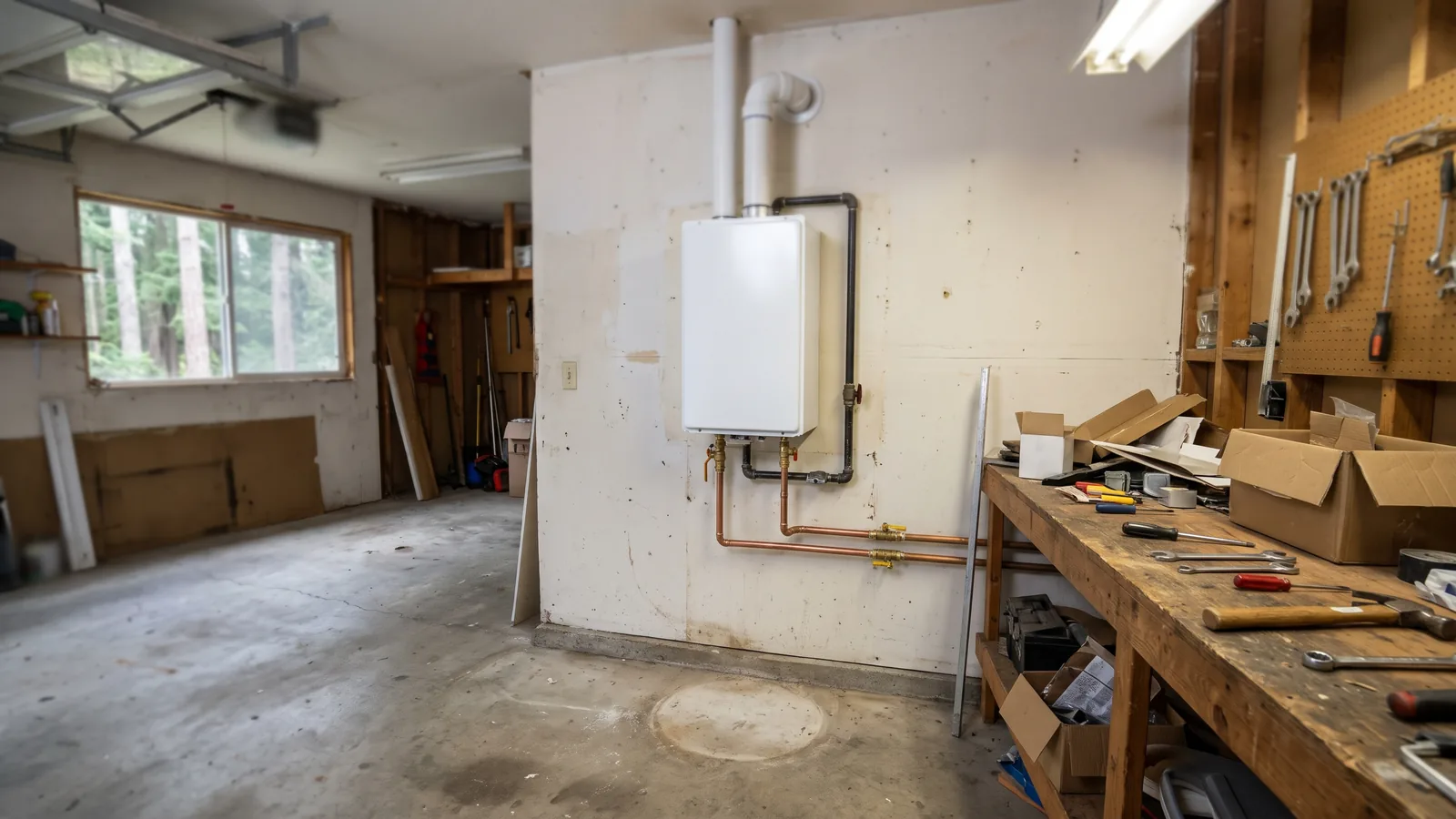
Residential Tankless Water Heater Installation in Kent
Most calls are about the main heater for the house, so the list starts with full installs and conversions and works down to the smaller jobs.
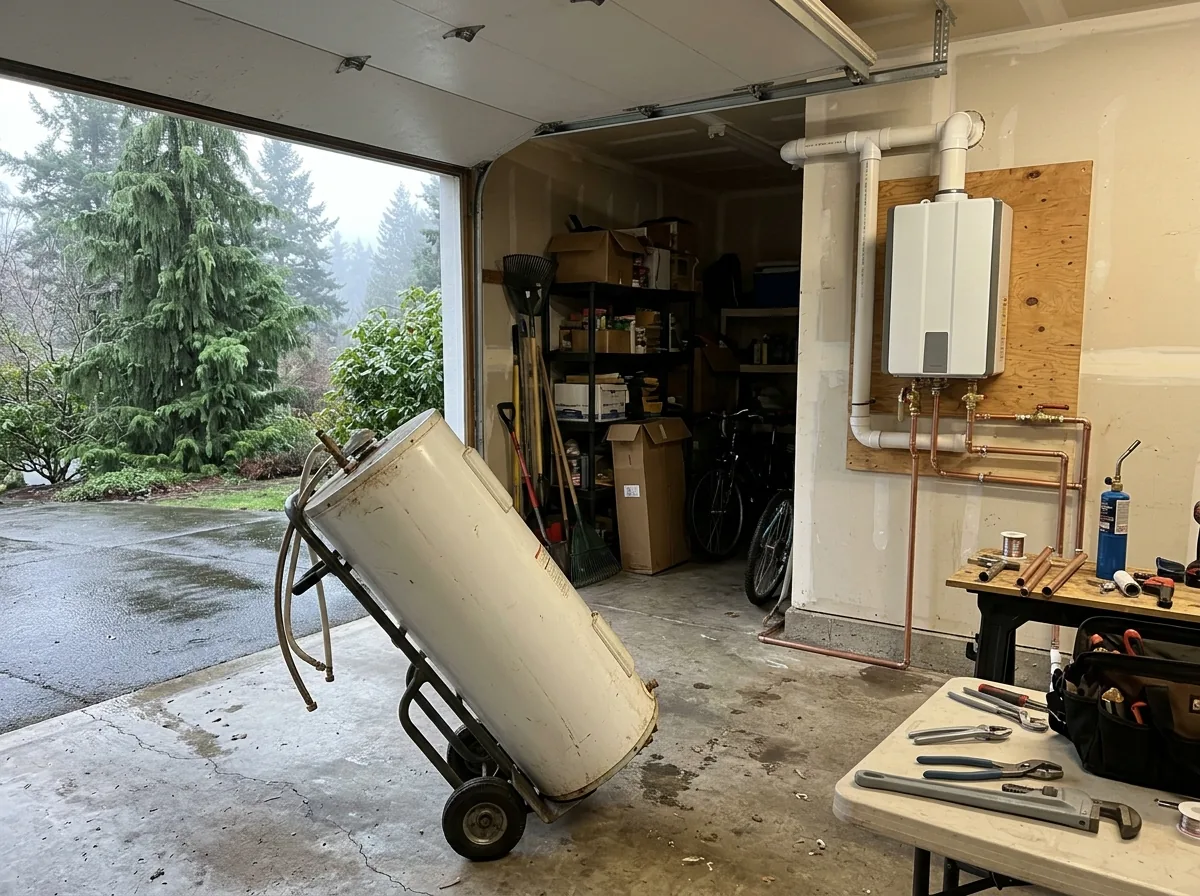
Tank-to-Tankless Conversion
Going from a tank to tankless is closer to a small remodel than a swap. The heater comes off the floor and onto the wall, and the pipes and wiring around it usually change too. The gas line often has to get bigger (HomeGuide: $350 to $2,000). A new vent goes in as well ($100 to $600 on HomeGuide's numbers), because the tank's flue can't serve a tankless heater. An electric model needs a dedicated circuit ($250 to $900), and sometimes a new panel ($850 to $1,700). Hauling the old tank away adds $75 to $500.
Washington's earthquake strapping rule is written around tanks. A wall-hung tankless unit goes up the way its manual says, and the state code makes that manual binding.
See tank-to-tankless conversion for each fuel's route and what happens to the old flue and tank.
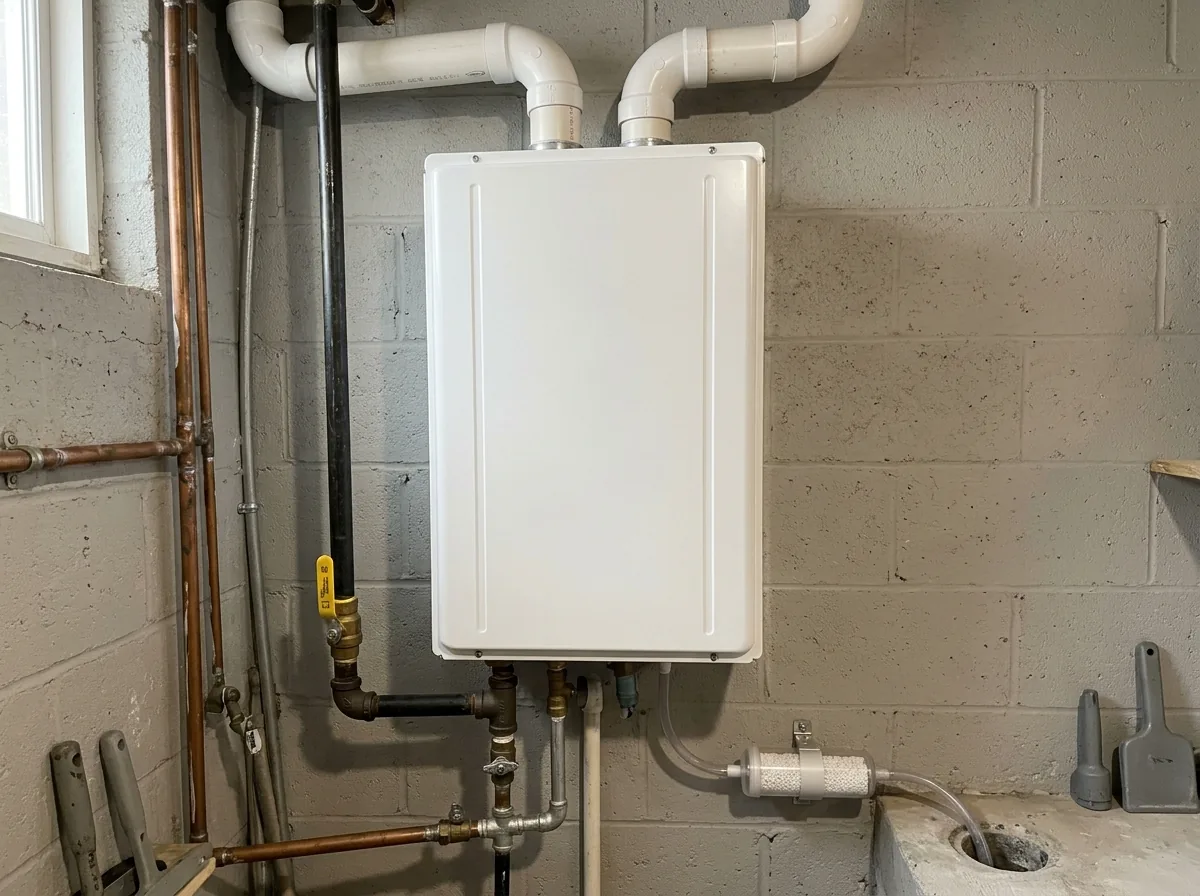
Gas Tankless Water Heater Installation
Puget Sound Energy supplies natural gas in Kent, and DOE notes that gas-fired tankless units deliver more flow than electric ones. HomeGuide puts a gas unit at $2,100 to $5,600 installed. The first choice is condensing or non-condensing. A condensing heater pulls extra heat from its exhaust and drains the condensate it makes; a non-condensing one costs about 25% less to install, by HomeGuide's figure.
For efficiency, ENERGY STAR's line for a gas tankless heater is a uniform energy factor (UEF) of at least 0.95, and its definition covers burners under 200,000 Btu per hour. Rinnai's RX199iN, one whole-house model, is rated at 199,000 Btu/h and a UEF of 0.98. DOE also suggests choosing a model with intermittent ignition rather than a standing pilot, which burns gas all day.
See gas tankless water heater installation for condensing and non-condensing models side by side.
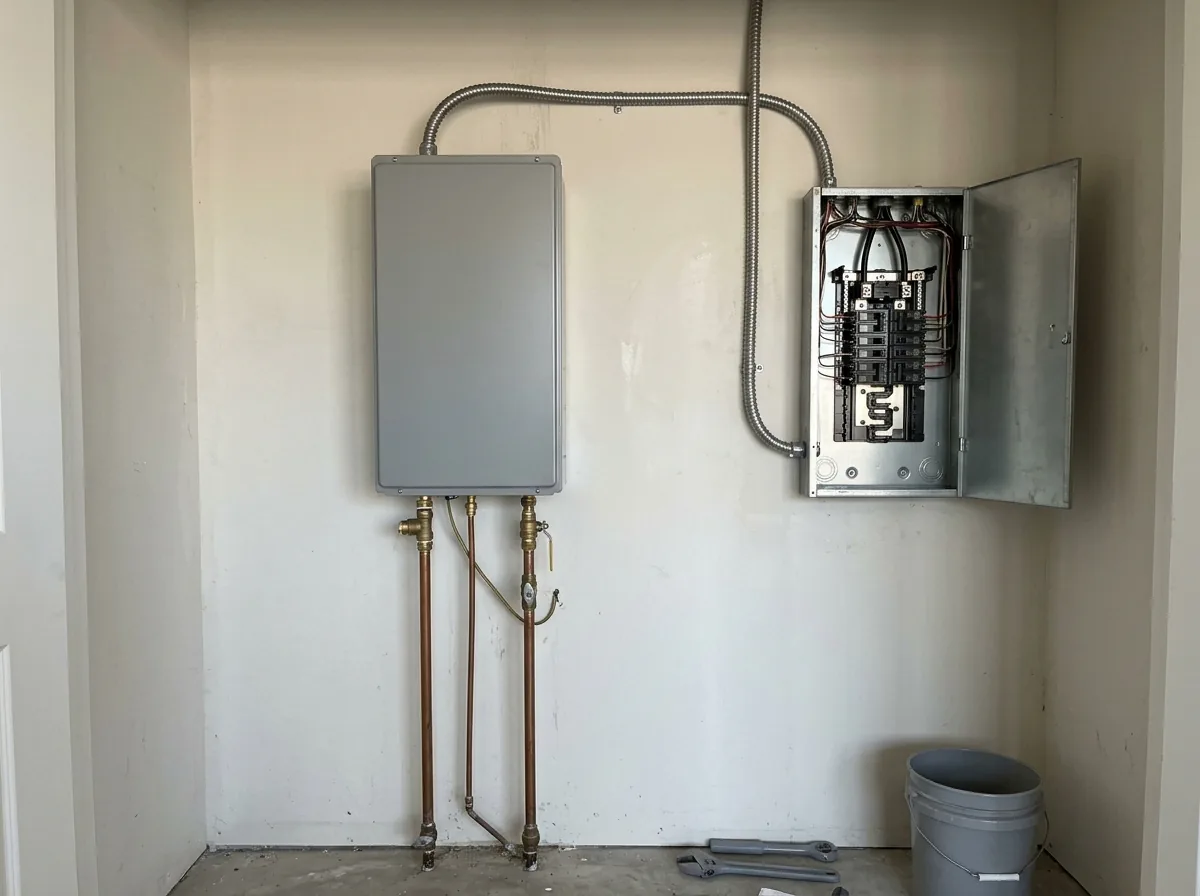
Electric Tankless Water Heater Installation
Electric units cost less up front, $1,400 to $3,000 installed on HomeGuide's numbers, but they ask a lot of the electrical panel. One installer quoted by HomeAdvisor puts a whole-house electric model at 240 volts and 80 amps or more, in a home with at least 150-amp service. Ask early whether your panel has the room.
Flow is the other limit. DOE says a 70°F temperature rise usually comes at about 2 gallons a minute through an electric unit, against about 5 through a gas one. That figure assumes 50°F inlet water, and Rinnai's map puts western Washington near 52°F, so an electric whole-house heater here suits a smaller household better than a busy one. The wiring needs a Washington L&I electrical permit, not a city one.
See electric tankless water heater installation for breaker, wire and panel sizes by model.
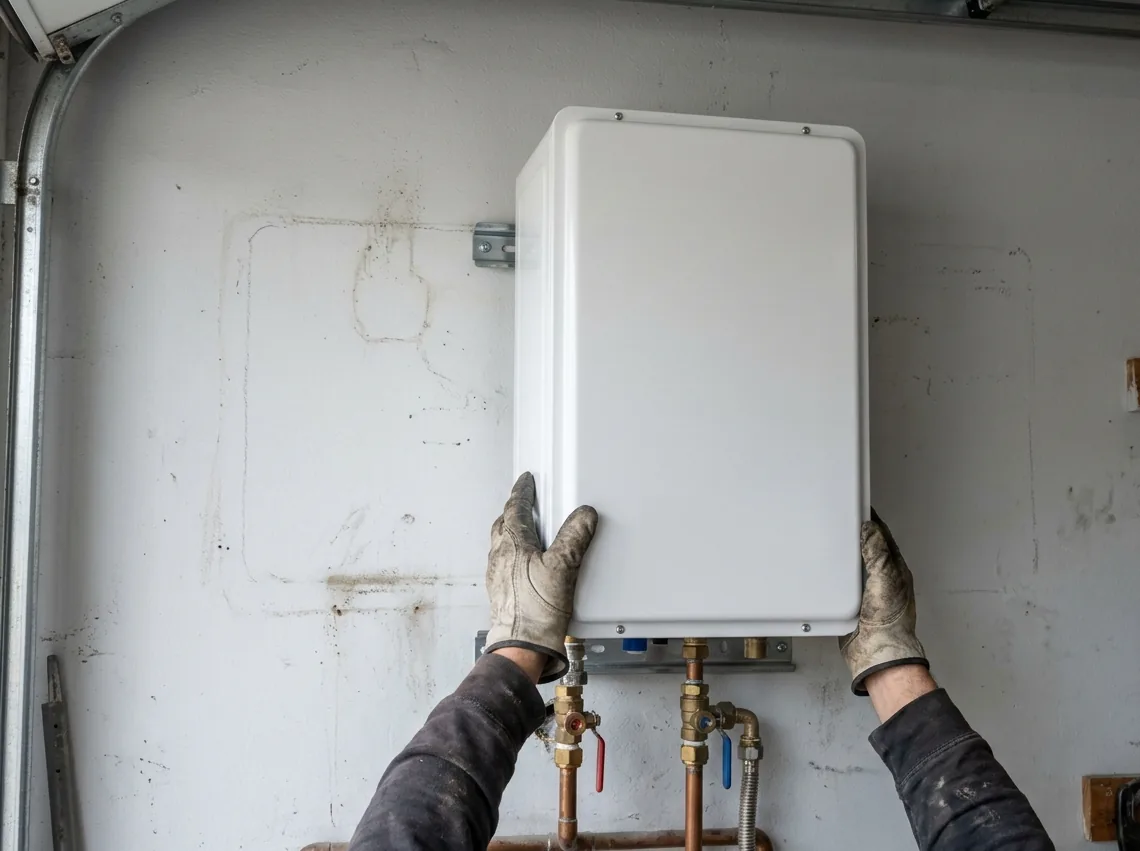
Tankless Water Heater Replacement
An older tankless heater that acts up isn't always finished. DOE says most last more than 20 years and that their parts are easy to replace, so repair is worth pricing first. When it isn't, a like-for-like swap is the simplest job. Changing brands or moving to a bigger model brings back the conversion questions: is the gas line sized for the new burner, and does the existing vent meet the new manual? Washington's code requires the installation to follow that manual, so a good plumber checks both before quoting.
See tankless water heater replacement for the age at which a new unit beats another repair.
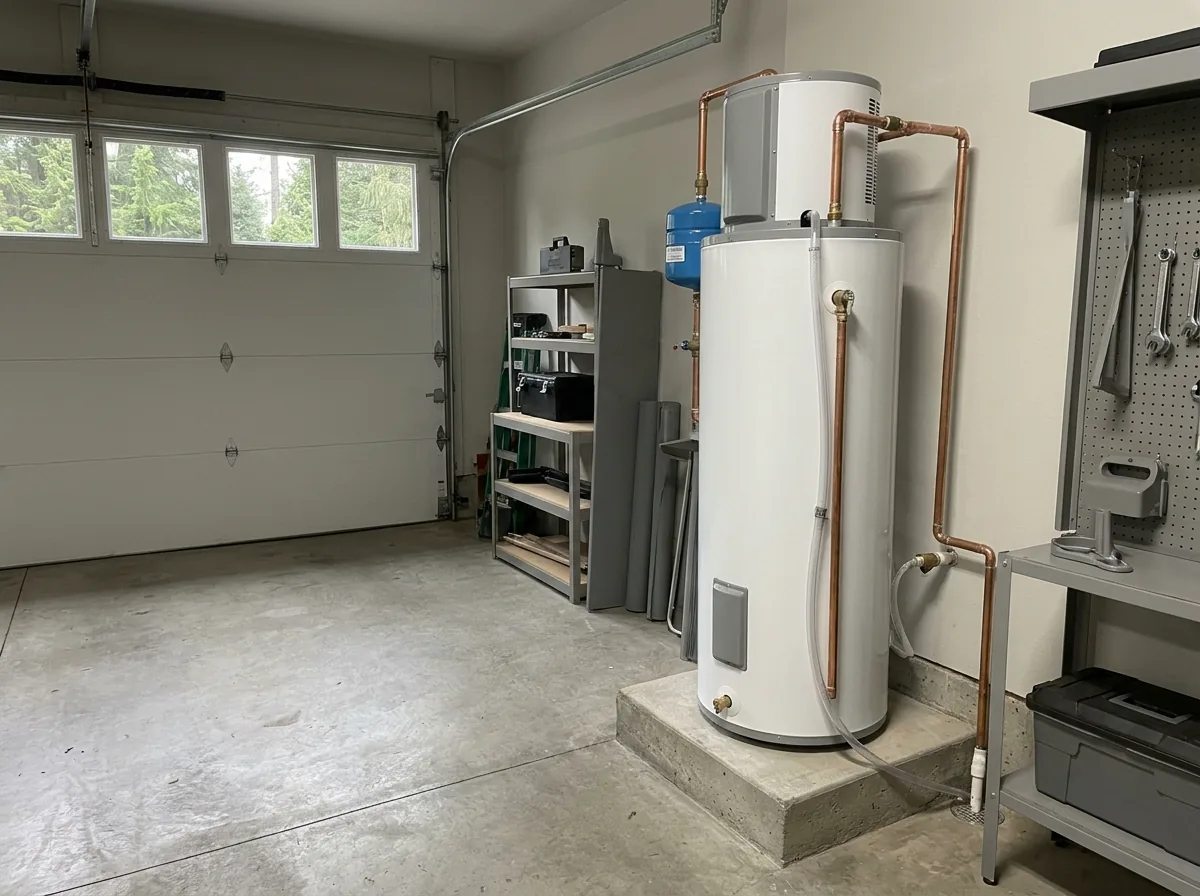
Water Heater Replacement: Tank, Tankless or Heat Pump
Not every failed heater should become a tankless one. A new tank costs $600 to $3,100 installed, per HomeGuide, and it's the fastest way back to hot water when the old one has leaked. In Kent, an electric tank swap is a plumbing minor work permit and a gas tank swap is a mechanical one.
Washington also sets strapping and garage-height rules for a new tank. A heat pump water heater is the third option, and the only one Puget Sound Energy currently offers a rebate on.
See water heater replacement and installation for those rules and what each tank type costs.
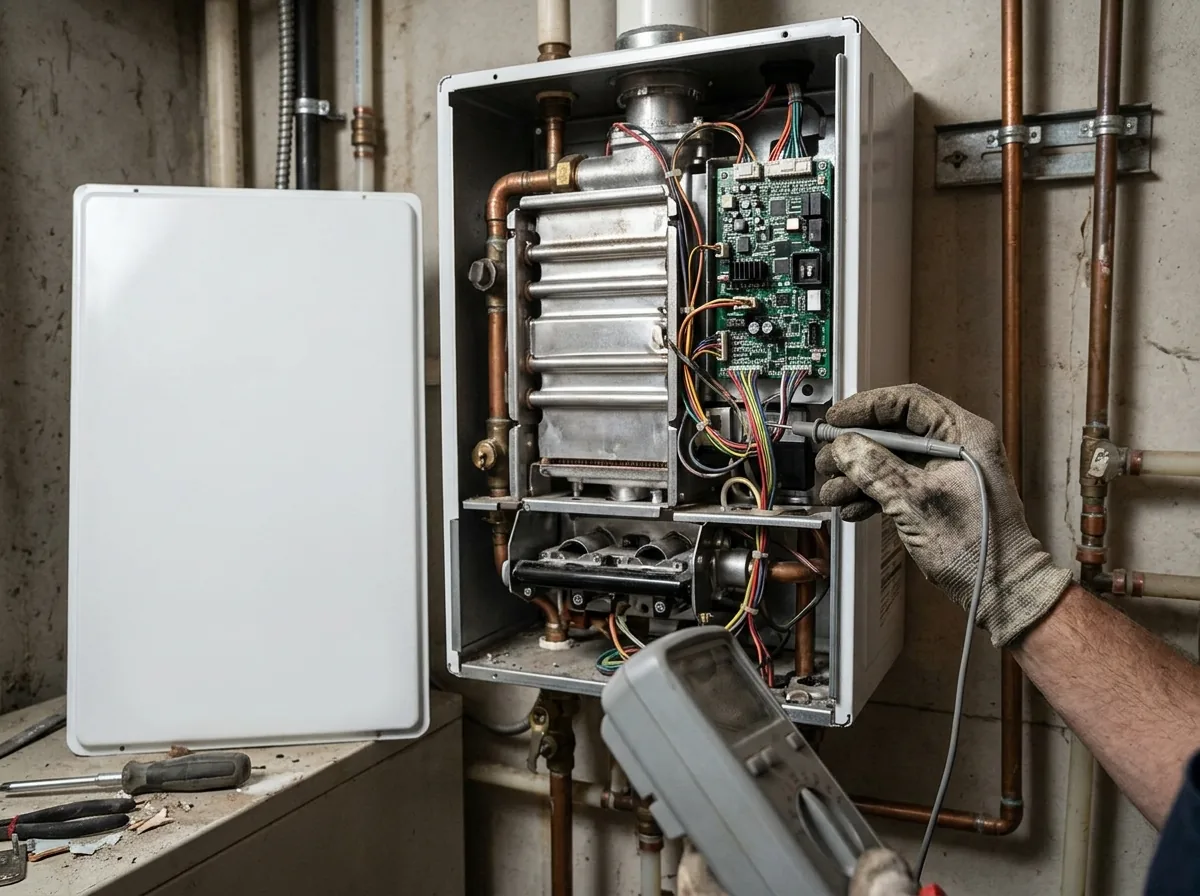
Tankless Water Heater Repair and Error Codes
When a tankless heater stops making hot water, its display usually shows an error code. Write it down along with the brand and model number before you call: the code points to the fault group, such as ignition, flame or venting, and the manual lists what each one means. Lukewarm water during a long shower can also mean the heat exchanger is scaled up. Rinnai notes that scale forms faster when the heater is set to a high temperature.
Ask the plumber to look at the gas supply and the vent as well as the unit. A heater installed on an undersized gas line or a blocked vent will keep throwing the same codes after the part is replaced.
See tankless water heater repair for what the common codes mean, or water heater repair when the trouble is a tank's pilot, element or thermostat.
Tankless Flushing and Descaling in Kent
The City of Kent's 2025 water quality report lists hardness from 46.7 to 123 mg/L. On the USGS scale, that runs from soft at the low end to the bottom of "hard" at the top. Kent mixes water from 16 wells, 2 springs and the Green River, so the number at your tap depends on the mix. Parts of the city are served by other districts entirely.
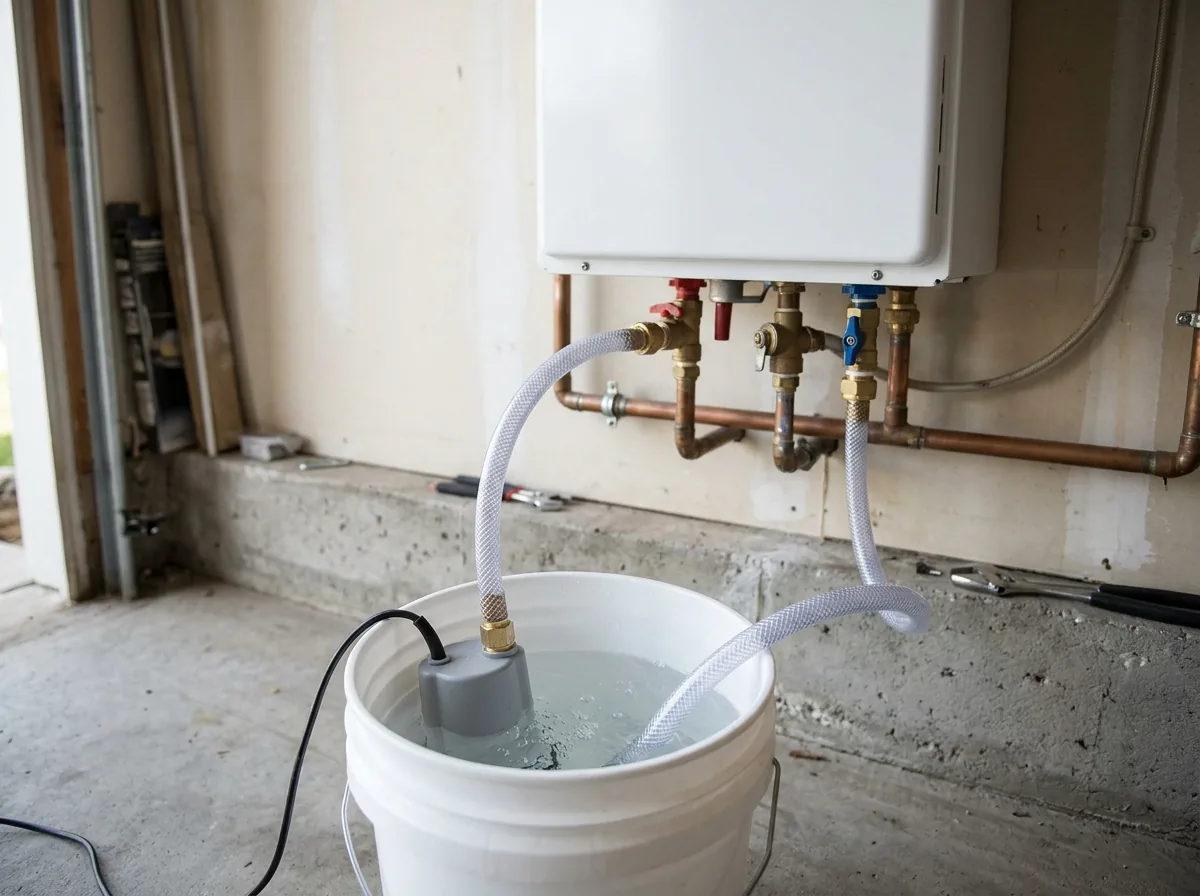
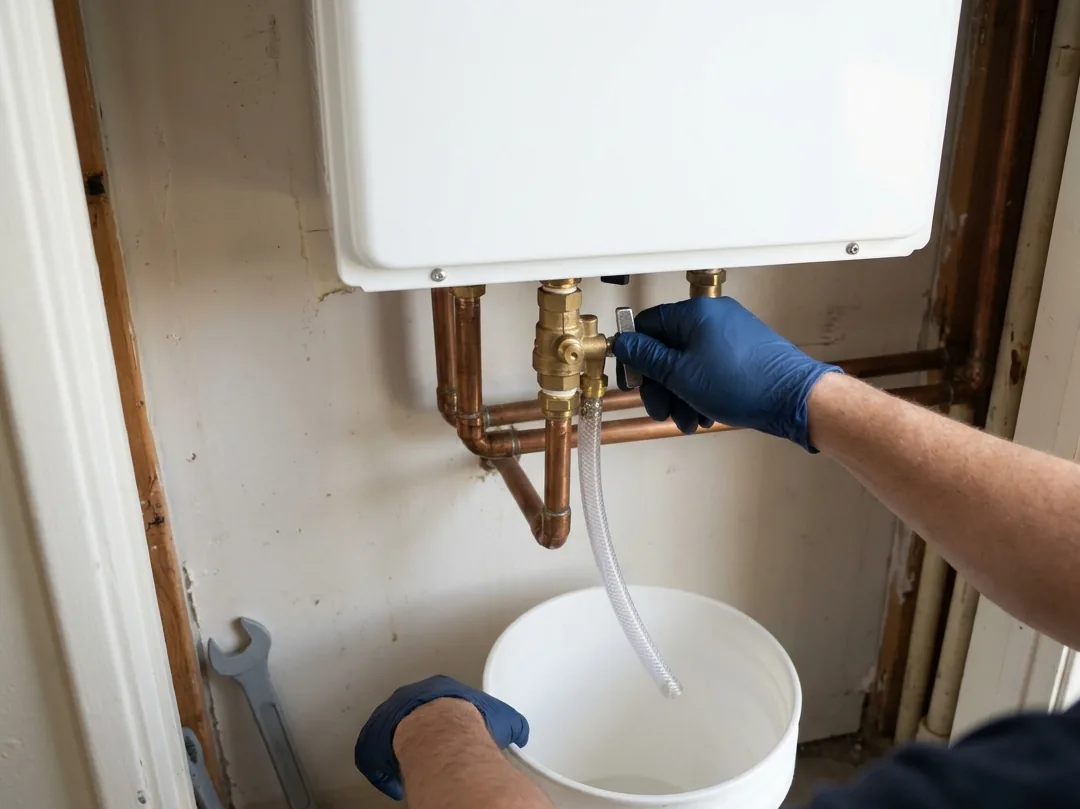
Hard water leaves scale in the heat exchanger. Rinnai's manual says scale damage isn't covered by warranty, and Rinnai wants a professional to flush the unit every year. Navien and Noritz also recommend yearly service. The job uses the service valves under the unit, a small pump and a descaling solution circulated through the heater, the way the photo shows.
See tankless water heater maintenance for the flush step by step; a tank has its own anode and sediment routine, covered under water heater maintenance.
Gas Line Sizing for a Tankless Heater
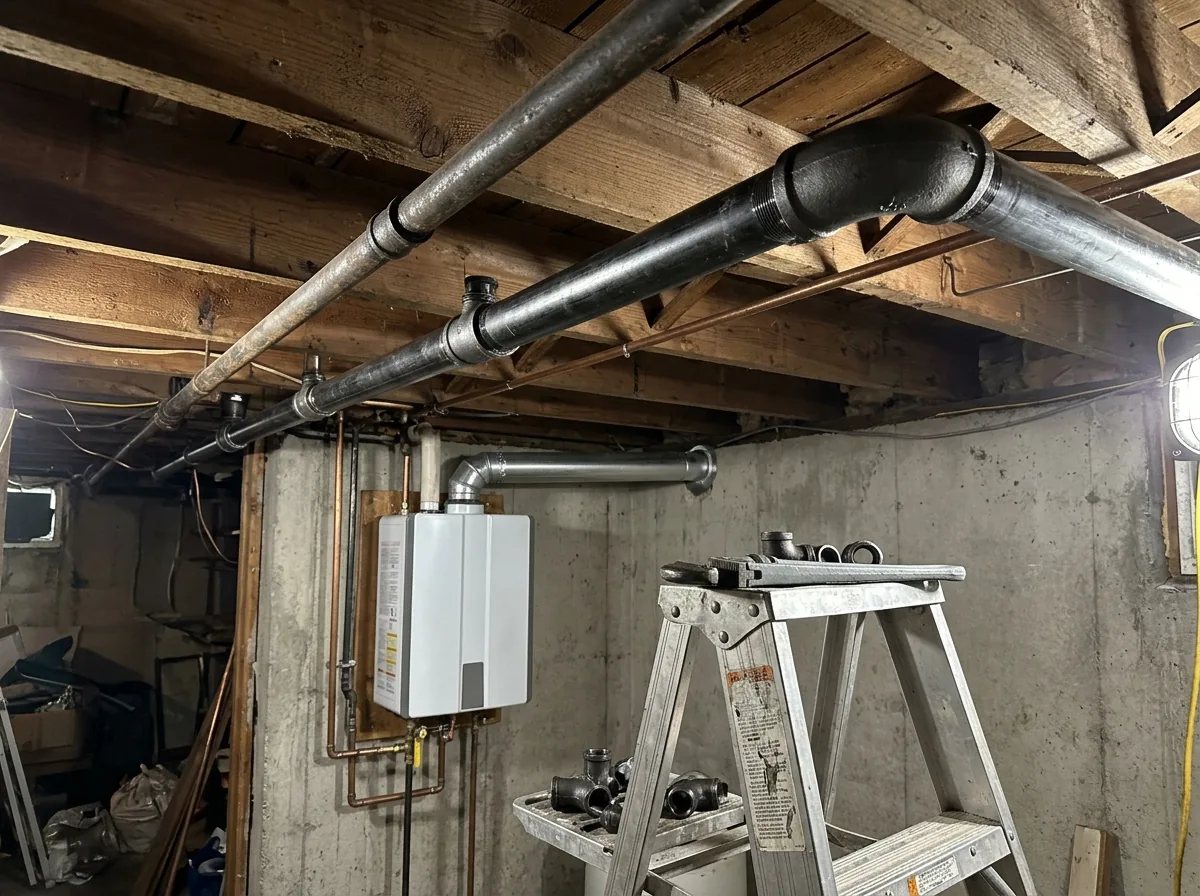
A tankless burner fires only while hot water runs, but at full demand it can draw close to 200,000 Btu an hour. A gas line sized for a tank heater often can't feed that, and an undersized line shows up as weak hot water and error codes when the furnace and stove run too. The fix is a larger pipe from the meter or a branch line, which HomeGuide puts at $350 to $2,000. In Kent, gas piping is permitted as mechanical work, separately from the water side.
See tankless water heater gas line for pipe sizes by Btu load and run length.
Tankless Venting: PVC, Concentric and Direct Vent
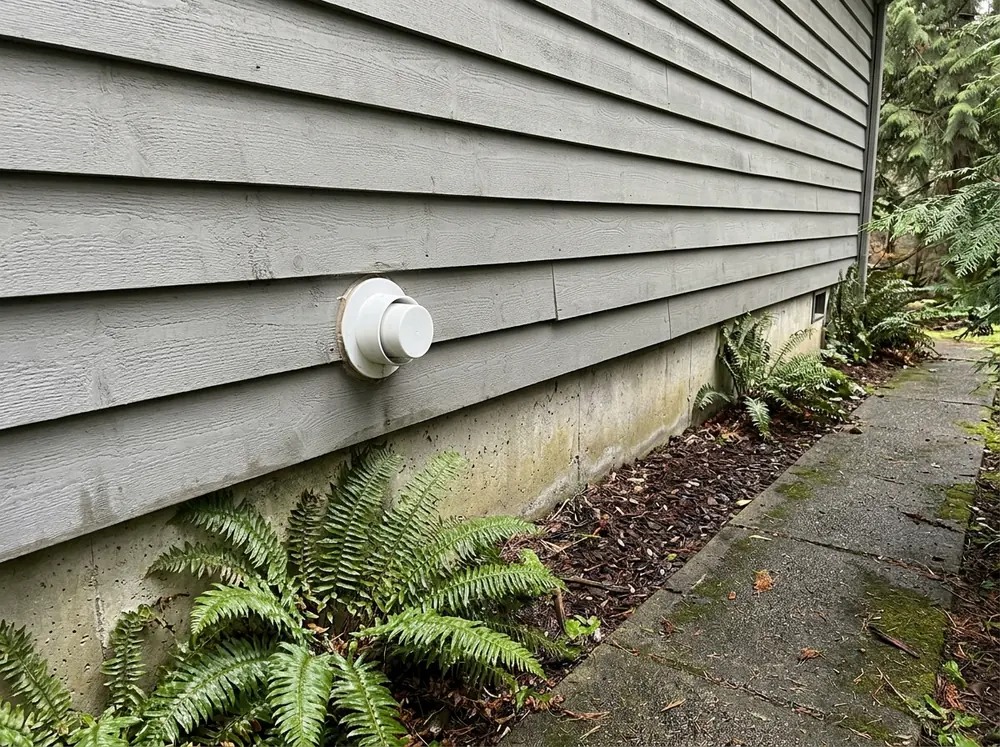
Where the vent goes often decides where the heater goes. A condensing unit's cooler exhaust usually leaves through plastic pipe, often as one concentric pipe through a sidewall, which lets a garage or basement unit vent out the nearest wall. The pipe material, length and clearances come from the manufacturer's manual. Washington's code makes that manual binding and routes vents and combustion air through the Mechanical Code. A gas heater in a bedroom or bathroom must be a direct-vent type, or sit in a sealed, self-closing closet fed with outdoor air.
See tankless water heater venting for vent materials, wall and roof exits, and clearances.
Hot Water Recirculation Pump Installation
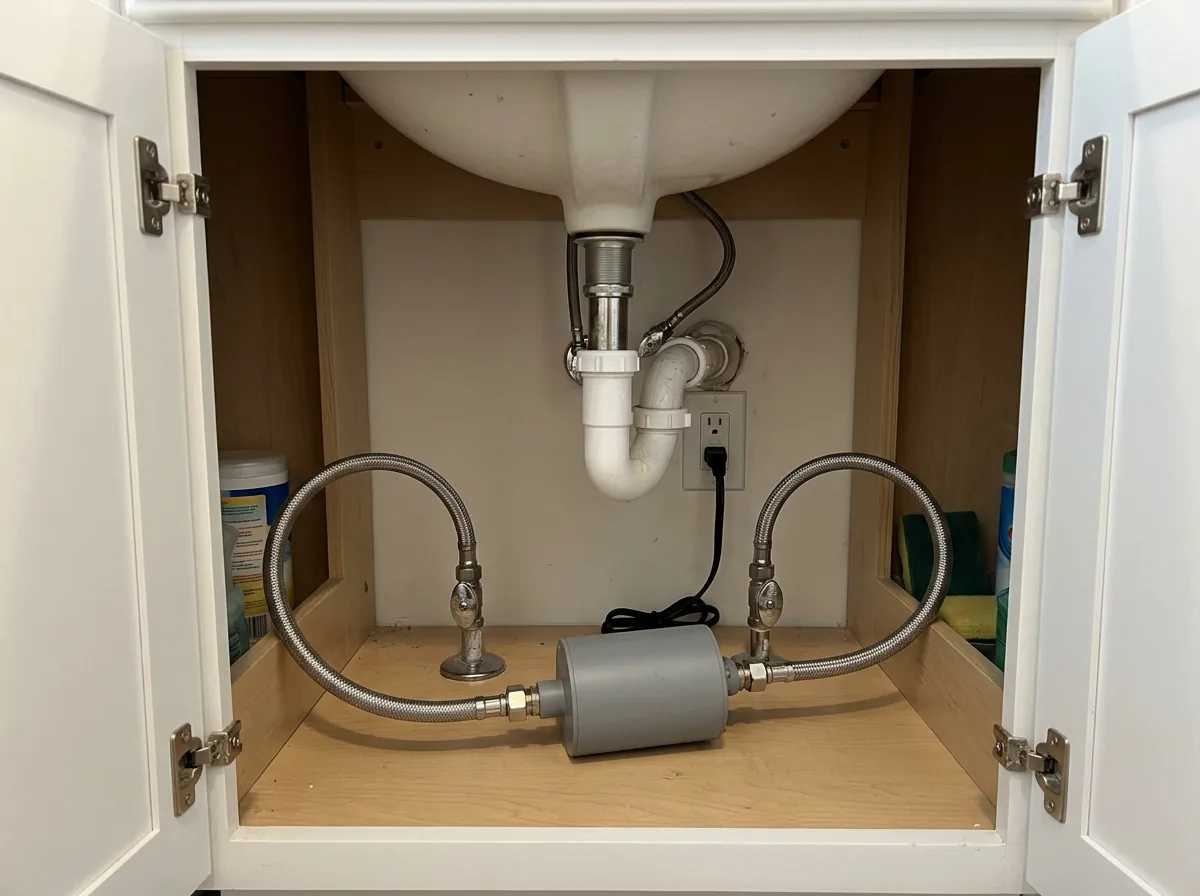
A tankless heater doesn't shorten the walk from the heater to a far bathroom; whatever has cooled in the line between them comes out of the tap before the hot does. A recirculation pump fixes that by keeping hot water near the fixtures. In an existing house the usual retrofit is a small pump and a crossover valve under the farthest sink, which sends the cooled water back through the cold line. A dedicated return line is cleaner but means opening walls. Some tankless models handle recirculation themselves; Rinnai's SENSEI manual, for one, describes starting it from a push button. Check the model before buying a separate pump.
See hot water recirculation pump installation to compare a crossover kit with a full return line.
Point-of-Use Tankless Heaters
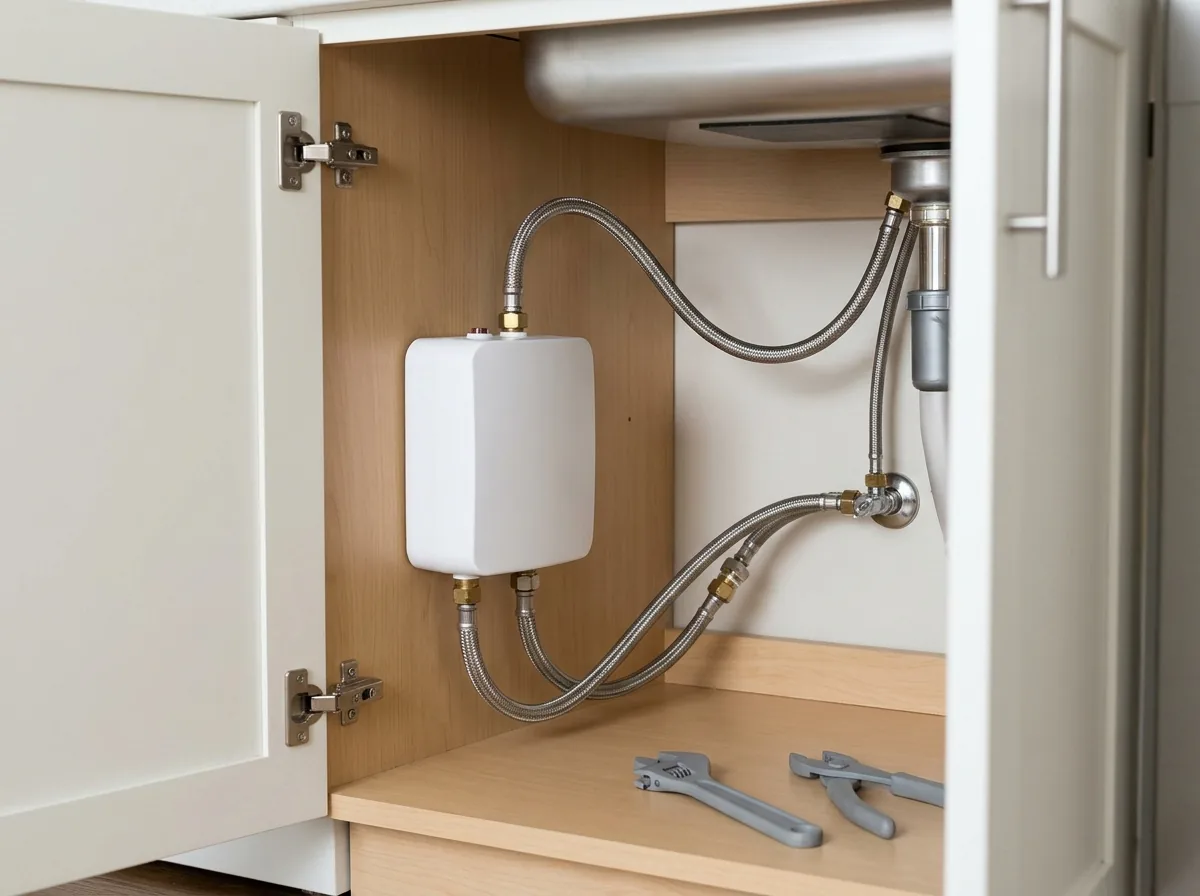
A point-of-use heater is a small electric unit under one sink or near one bathroom. It suits a sink far from the main heater, a garage addition or an ADU, and it can back up a main unit that struggles with distance. It still needs its own circuit, which HomeGuide prices at $250 to $900 when one has to be added.
See point-of-use water heater installation for under-sink and booster setups.
Heat Pump Water Heater Installation
A heat pump water heater keeps a tank but heats it with a compressor. Right now it's the one water heater Puget Sound Energy rebates: $1,000 for a qualifying unit, or $1,100 for income-qualified households. Eligibility is narrow (PSE electric customers in existing single-family homes, applying within 30 days of the install), and the federal tax credit that used to cover these heaters ended with 2025.
See heat pump water heater installation for the full rebate rules and how much room the unit needs.
Commercial Tankless Water Heaters in Kent
Businesses run hot water harder and more predictably than homes, so the setups below are sized around the busiest hour.
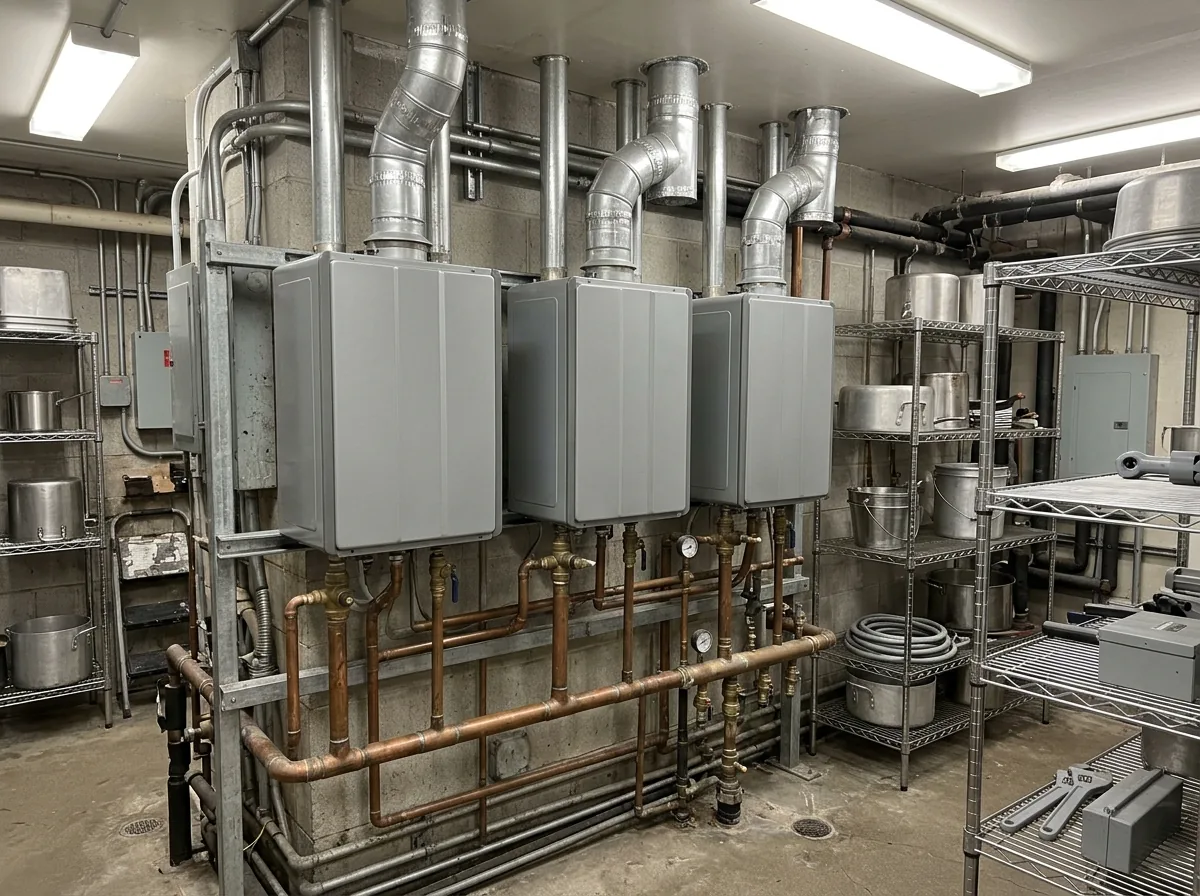
Restaurant and Commercial Kitchen Hot Water
A busy kitchen can outrun one heater, so commercial installs often mount several tankless heaters side by side on a steel frame, tied together with manifolds. When demand rises, more of them fire; when one needs service, the others carry on. The trade-off is upkeep. Rinnai's manual sets descaling for commercial use in hard water at twice a year, against once a year for a house.
See restaurant water heaters for the food code's hot-water temperatures and booster setups.
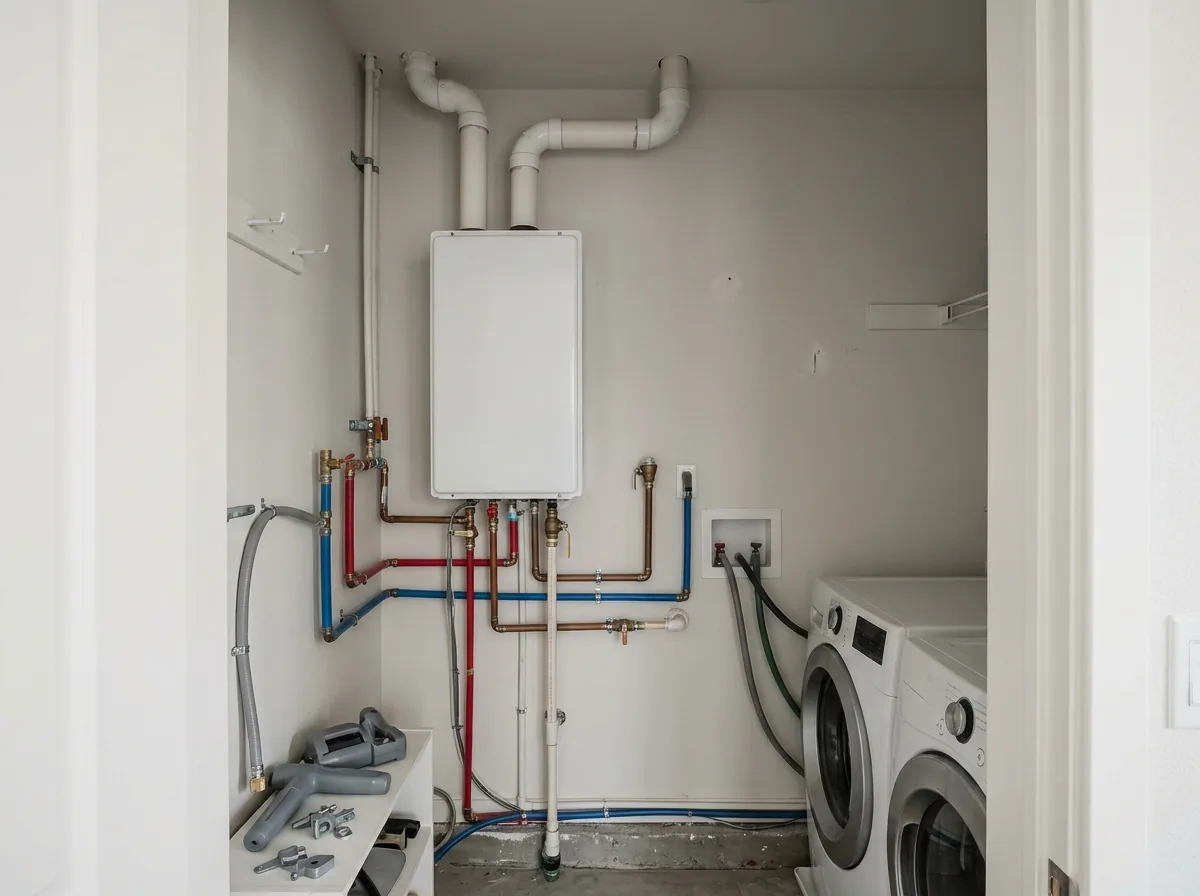
Apartments, Townhomes and HOAs
In multifamily buildings each unit often has its own small heater in a closet, so replacements come one door at a time, with tenants to schedule around. Venting is the sticking point, and the bedroom and bathroom closet rule under venting above applies to every unit. For an HOA or a manager planning several units, ask for the price per unit in writing.
See tankless water heaters for apartments for one heater per unit versus a central plant, and for HOA approval.
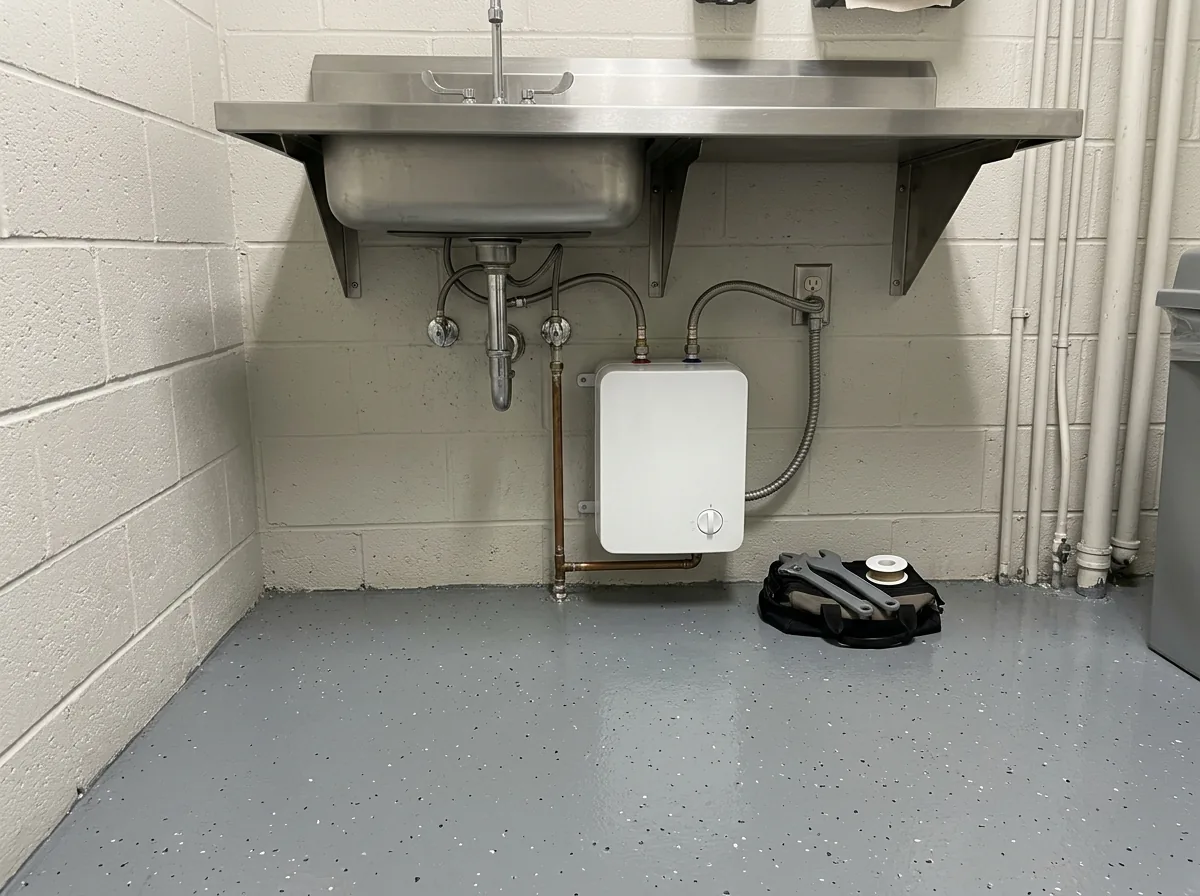
Offices, Retail and Light Industrial Buildings
Warehouses and offices tend to use little hot water, spread across restrooms and break rooms a long way apart. Small electric point-of-use heaters under each sink often beat one central heater and a long pipe run. Property managers should know one rule: since July 1, 2021, plumbing contract work in Washington must be done by a licensed plumbing contractor, and general contractors can't bid it.
See commercial tankless water heater installation for a new system, or commercial water heater repair when an existing heater or booster has failed.
Get a free tankless water heater estimate in Kent
- Your details go to a single independent plumber, not a list of bidders
- The referral is free, and booking is your call
- Ask for gas line, vent and wiring costs as separate lines
- Ask which Kent and L&I permits the job needs
- Keep the down payment small and pay as work is finished
Specialty Water Heater Services
These are smaller jobs that often come up during an install or a repair visit.
Water Heater Leak Repair
A leak at the fittings, the relief valve line or the heater itself starts with the cold-water shutoff above or below the unit. Close it and turn the heater off at the gas valve or breaker. Washington's code doesn't allow the relief valve to drain into a pan, so a dripping pan points to a different leak.
See water heater leak repair to trace a leak by where the water shows up.
Expansion Tank and Relief Valve Work
The temperature and pressure relief valve is the heater's safety outlet. Rinnai's manual calls for one rated to 150 psi and to at least the heater's maximum Btu, operated by hand once a year. Washington wants its discharge pipe full size and rigid, with no valves, ending 6 inches to 2 feet above the floor and pointing down. Ask whether your system also needs an expansion tank.
See water heater expansion tank installation to find out whether your plumbing calls for one.
Water Softener and Scale Protection
Rinnai's water table treats 61 to 120 mg/L as slightly hard and 121 to 160 as moderately hard, and recommends a softener or scale treatment from that level up. Kent's water runs 46.7 to 123 mg/L, so homes at the upper end of that range fall in those bands. A scale filter ahead of the heater is the smaller step; a whole-house softener is the larger one.
See water softeners for tankless heaters for the options from a scale cartridge up to a full softener.
Propane Tankless Heaters Off the Gas Main
Homes without a natural gas line can run a tankless heater on propane. HomeGuide puts a propane unit at $1,600 to $4,500 installed. The heater has to be ordered or converted for propane, and the tank and regulator have to keep up with the burner.
See gas and propane tankless installation for what changes on a propane unit.
Combi Boiler and Tankless Space Heating
One wall-hung combi boiler can take over both jobs, house heat and tap water, often in the corner where a furnace and a tank used to stand. It's a heating system first, so the gas, venting and permit questions are larger than for a water heater alone.
See combi boiler installation for radiant floor, baseboard and air-handler setups.
Permits and Inspections in Kent
Kent takes residential permit applications online through its Citizen Portal. Plumbing and mechanical minor permits have no intake appointment or formal review, and inspections can often be booked for the next business day. Intake fees are due within 15 days or the application is canceled. Starting before a required permit triggers an investigation fee. Kent's 2026 fee table doesn't list a water heater fee, so ask what the permit adds to the quote.
See the water heater replacement page for which Kent permit covers a gas tank and which covers an electric one.
How Much Does a Tankless Water Heater Cost in Kent?
No cost guide publishes a Kent or Washington figure for tankless installs, so the ranges below are national. The house decides where a job lands within them.
| Item | National range | Source |
|---|---|---|
| Gas tankless, installed | $2,100 to $5,600 | HomeGuide |
| Electric tankless, installed | $1,400 to $3,000 | HomeGuide |
| Propane tankless, installed | $1,600 to $4,500 | HomeGuide |
| Typical install, second guide | $1,404 to $3,903 (average $2,640) | HomeAdvisor |
| Installation labor | $600 to $2,500 | HomeGuide |
| Larger gas supply line | $350 to $2,000 | HomeGuide |
| New exhaust venting | $100 to $600 | HomeGuide |
| Dedicated electrical circuit | $250 to $900 | HomeGuide |
| Electrical panel replacement | $850 to $1,700 | HomeGuide |
| Old tank removal and disposal | $75 to $500 | HomeGuide |
| Permits | $50 to $200 (HomeAdvisor: up to $500) | HomeGuide, HomeAdvisor |
| Tank water heater, for comparison | $600 to $3,100 | HomeGuide |
What moves the price is mostly the house: how far the new heater sits from the gas meter, whether the panel has room, and where the vent can go out. A like-for-like tankless swap avoids most of the add-on lines; a first-time conversion can use several of them.
Two incentives often quoted online don't apply. The federal 25C credit covered installs through December 31, 2025, so a 2026 tankless install gets nothing from it. PSE's 2026 water heating rebates list only heat pump water heaters, with no gas tankless rebate. On payment, Washington's Attorney General suggests keeping the down payment to 10 to 20 percent, and L&I advises paying as phases are finished.
Tank, Tankless or Heat Pump in a Puget Sound Home
Sizing starts with flow, not floor area. DOE's method is to add up the fixtures you run at once: a 0.75 GPM faucet and a 2.5 GPM shower need at least 3.25 GPM. Then work out the temperature rise. Western Washington's ground water sits near 52°F on Rinnai's map, which makes a 120°F setting a 68°F rise; the electric tankless page runs the same math for electric units. At that inlet temperature Rinnai rates its 199,000 Btu/h unit at 5.7 GPM for 105°F showers. That's two 2 GPM showers with a little to spare, and more than DOE's typical electric rating of about 2 GPM.
Savings depend on how much hot water the house uses. A light-use home (41 gallons of hot water a day or under) gains 24% to 34% in efficiency over a tank, by DOE's estimate; a heavy-use home near 86 gallons gains only 8% to 14%. The busier the household, the smaller the gain, and the more likely it needs a large gas unit or two.
Washington's plumbing code sizes heaters without tanks by a first-hour table: a 3-bedroom house with 2 to 2.5 baths calls for 62 gallons. A tank heats ahead and runs out; tankless heats on demand but caps the flow; a heat pump tank is the one that earns the PSE rebate. If showers overlap in your house, give tankless flow the most weight.
How Your Tankless Request Is Handled
STEP 01
Tell us what you have now
Call or send the form with the heater's fuel (gas, electric or propane), its age, where it sits and what's wrong. Photos of the label and the vent help.
STEP 02
One independent plumber follows up
Kent Tankless Water Heater passes your details to a single independent plumber licensed in Washington, who calls you back. You pay nothing for the referral; ask up front if the plumber charges for coming out to look.
STEP 03
Site check and a written price
A good plumber looks at the gas meter, the panel and the vent route before pricing a conversion. DOE advises getting written estimates. Check the contractor's registration and plumbing license on L&I's lookup, and expect the Washington disclosure statement on jobs of $1,000 or more.
STEP 04
Permit before work starts
DOE suggests confirming the installer will pull the local permit. In Kent that's a city plumbing or mechanical permit, plus an L&I electrical permit for new wiring.
STEP 05
Install, startup and inspection
The plumber mounts the unit, connects water, gas or power, the vent and any condensate drain, then fires it and checks the temperature at a faucet. Keep the manual and the model number for the yearly descaling.
Areas Served in Kent, WA
Any address inside Kent city limits can use this line, house or business. Puget Sound Energy supplies the city's natural gas and electricity, so the PSE rebate rules above apply here. Water is a different story: the City of Kent water utility, with a 24-square-mile service area, serves most of the city, and districts such as Soos Creek Water & Sewer and Highline Water serve the rest. If another district serves your address, plan descaling around that district's water report rather than the city's.