
Hot Water Recirculation Pump Setups in Kent Homes
A recirculation system keeps hot water moving near the fixtures, so the cooled water in the pipe doesn't have to run down the drain first. There are two plumbing layouts and several ways to control them.
Pumps on a Dedicated Return Line
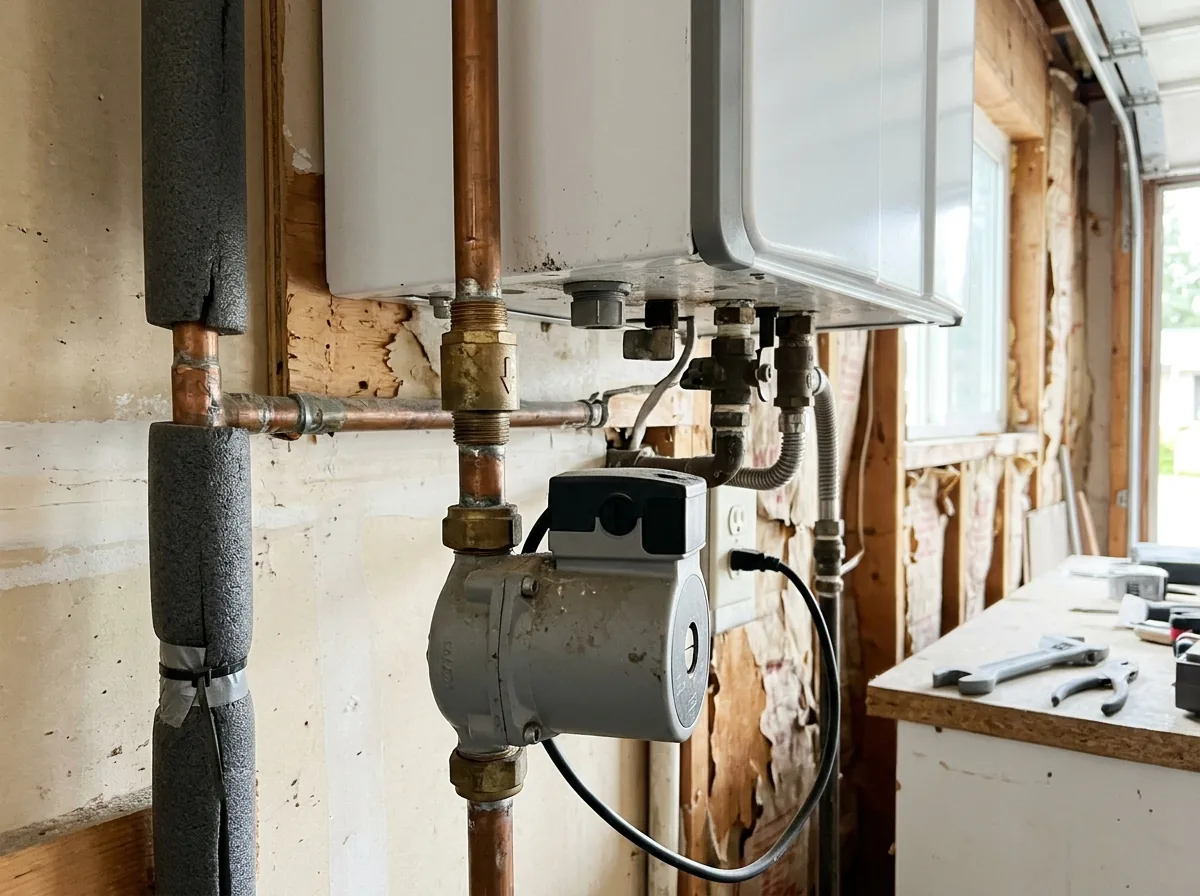
The cleanest system has its own pipe. Hot water runs out to the fixtures and a separate return line brings it back to the heater, with the pump at the heater end. HomeServe prices a dedicated loop at $2,000 to $7,000 installed, since, in HomeServe's words, it may require extensive plumbing work. Rinnai's checklist for its pump models includes confirming the return pipe length is within the maximum the manual allows.
Thermal Bypass Valve at the Farthest Fixture
The retrofit uses the cold line as the return. A thermal bypass valve goes between the hot and cold supplies at the fixture farthest from the heater; when the hot line cools, the valve lets that water cross into the cold pipe and flow back. HomeServe prices this kind of setup at $500 to $1,500. One catch on a Rinnai SENSEI heater: crossover mode needs its Low Activation Mode switched on. Rinnai ships the bypass valve with its pump models.
Recirculation-Ready Tankless Models
Some tankless heaters carry the pump inside. Rinnai's RXP199i and RXP160i are pump models, and a conversion kit adds the pump to the non-pump versions. A non-pump unit can also run an external pump through Rinnai's Circ-Logic control, with a harness bought separately. In either case the heater's settings choose between Economy mode (the pump cycles less, saving energy) and Comfort mode (it cycles more, keeping the loop hotter). Check what the existing heater supports before buying a separate pump.
Run Schedules, Push Buttons and Learned Use
Controls decide when the pump runs. HomeServe lists on-demand controls such as sensors, timers and push buttons. Rinnai's pump models offer three:
- Smart-Circ: the default; it learns usage over the first 24 hours and runs the pump ahead of the times you usually need hot water.
- Fixed schedule: set through a wired timer controller or a Wi-Fi module.
- Push button: up to five wireless buttons, to start the loop on demand.
Recirculation With a Tank Heater
Recirculation isn't a tankless-only fix. HomeServe describes the pump going either at the water heater or under the farthest fixture, which works with a tank too. A tank already has stored hot water, so the pump only has to deal with the pipe run. HomeGuide puts replacing a worn recirculating pump at $150 to $680, worth knowing on an older house that already has a loop.
Why Kent homeowners and businesses call Kent Tankless Water Heater
- Your details go to a single independent plumber, not a list of bidders
- The referral is free, and booking is your call
- Ask for gas line, vent and wiring costs as separate lines
- Ask which Kent and L&I permits the job needs
- Keep the down payment small and pay as work is finished
Tankless Recirculation and the Cold Water Sandwich
A tankless heater has a quirk a tank doesn't: the cold water sandwich. Eemax, which makes electric water heaters, explains it in a white paper. When a hot tap shuts off, a gas tankless heater shuts down. Turn the tap back on soon after and the burner has to go through ignition again, which takes about 10 seconds in most gas heaters. The cold water that passes through during that restart arrives at the tap between two slugs of hot water.
That's a different problem from the long wait at a far bathroom, and the fixes differ:
Long wait at a far tap
recirculation keeps the pipe warm, so hot water arrives sooner. Pump models like Rinnai's handle it on a schedule.Cold burst after a pause
Eemax's answer is a small electric mini-tank on the heater's hot outlet that blends out the cold slug.
When you call, say which one you have. Lukewarm water during a long shower, rather than a burst after a pause, points to a heater problem instead (tankless repair).