
Restaurant Hot Water, Sink by Sink
A kitchen's hot water load is a list of fixtures with rules attached, so it's easiest to size one sink at a time.
Handwashing Sinks
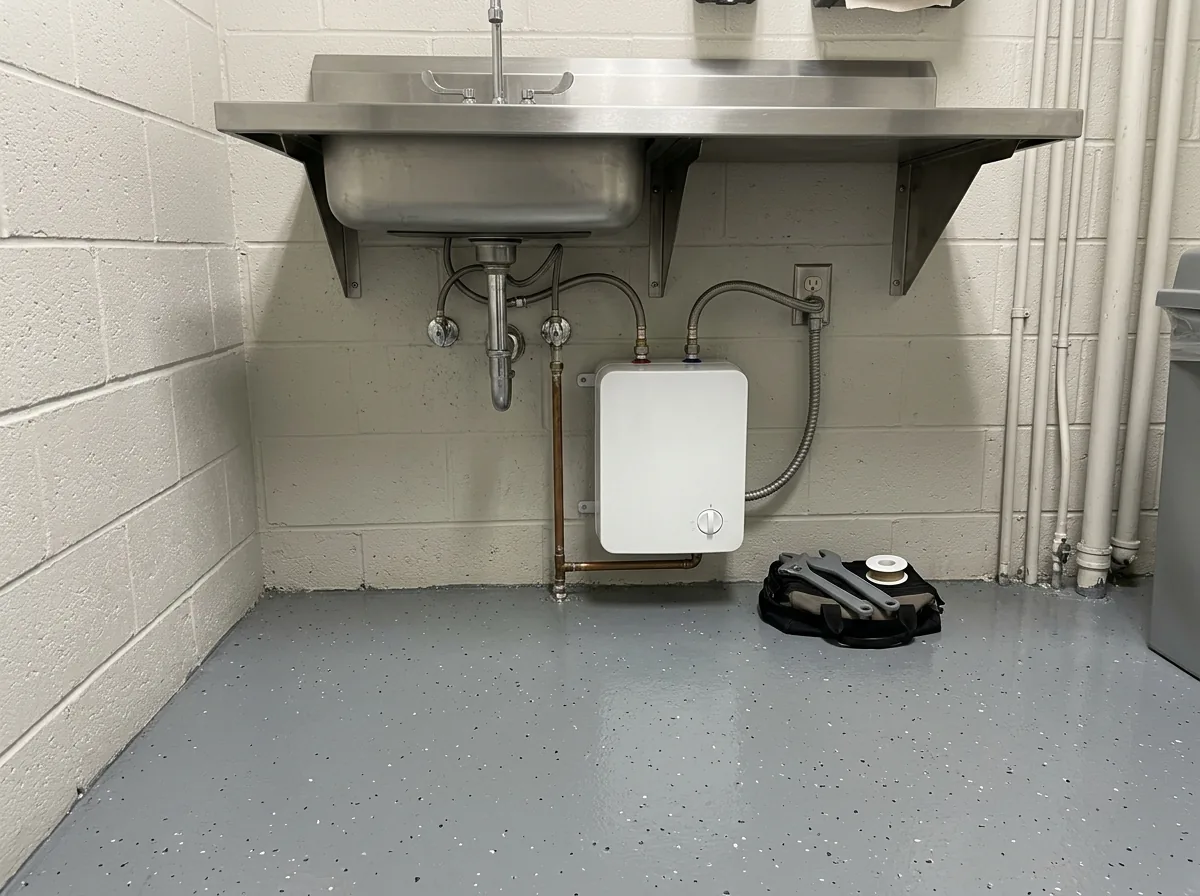
Washington requires each handsink to deliver at least 100°F through a mixing valve or combination faucet, and bans steam mixing valves there. A self-closing or metering faucet has to run for at least 15 seconds. King County wants handsinks within 25 feet of anywhere food or drinks are handled, so a large kitchen ends up with several. Its guide recommends feeding them from the main heater rather than small instant units under each sink.
Three-Compartment Sinks
King County requires a three-compartment sink in every food service, even one with a dish machine, and each bay must fit the largest pot or utensil. Washington sets the wash water at no less than 110°F, or the temperature on the detergent label. If the third bay sanitizes by hot water immersion instead of chemicals, it must hold 171°F or more. Filling three large bays at once is a heavy draw on the heater.
Booster Heaters at the Dish Machine
A machine that sanitizes with heat needs a final rinse well above what a building heater supplies. Washington's rule, measured as the rinse enters the manifold:
- Stationary-rack, single-temperature machine: at least 165°F.
- All other hot-water machines: at least 180°F.
- Ceiling: no more than 194°F.
A booster beside the machine makes up the gap. Hatco's Compact model stores 6 gallons and supplies the 180°F rinse. Chemical-sanitizing machines run cooler, 120 to 135°F in Hatco's figures.
Tankless Racks for Busy Kitchens
King County's plan review lists tankless and on-demand heaters among the accepted types, and Washington's food code requires the hot water system to meet peak demand throughout the establishment. A rack of tankless units does that by firing more heaters as the load rises. The rack layouts and vent options are on the commercial tankless page, and the descaling schedule on the tankless maintenance page.
Mop Sinks and Prep Sinks
The smaller sinks still count toward the load. King County requires:
- Mop or service sink: hot and cold water, with a vacuum breaker if a hose attaches to the faucet.
- Food prep sink: separate from the others, with an indirect waste drain; some kitchens need more than one.
- Dump or work sink: for liquid waste and rinsing utensils between uses; a handsink can't double as one.
Why Kent homeowners and businesses call Kent Tankless Water Heater
- Your details go to a single independent plumber, not a list of bidders
- The referral is free, and booking is your call
- Ask for gas line, vent and wiring costs as separate lines
- Ask which Kent and L&I permits the job needs
- Keep the down payment small and pay as work is finished
Washington Food Code Hot-Water Temperatures
Chapter 246-215 WAC is Washington's food code, and its numbers drive how the heater, booster and mixing valves are set:
| Use | Requirement | Rule |
|---|---|---|
| Handwashing sink | At least 100°F, via mixing valve or combination faucet | WAC 246-215-05210 |
| Manual warewashing, wash bay | At least 110°F, or the detergent label | WAC 246-215-04540 |
| Manual hot-water sanitizing | 171°F or above | WAC 246-215-04550 |
| Dish machine rinse, stationary single-temperature | 165°F to 194°F | WAC 246-215-04555 |
| Dish machine rinse, all other machines | 180°F to 194°F | WAC 246-215-04555 |
| Whole system | Meets peak hot water demand throughout | WAC 246-215-05135 |
King County Public Health, whose plan review guide is quoted above, lists "no hot water" among its reasons for immediate closure. A heater that can't make the 100°F at the farthest handsink during the rush falls short of the food code. Kent's permit split for commercial gas and electric heaters is on the commercial tankless page, and repair of an existing heater or booster on the commercial repair page.