
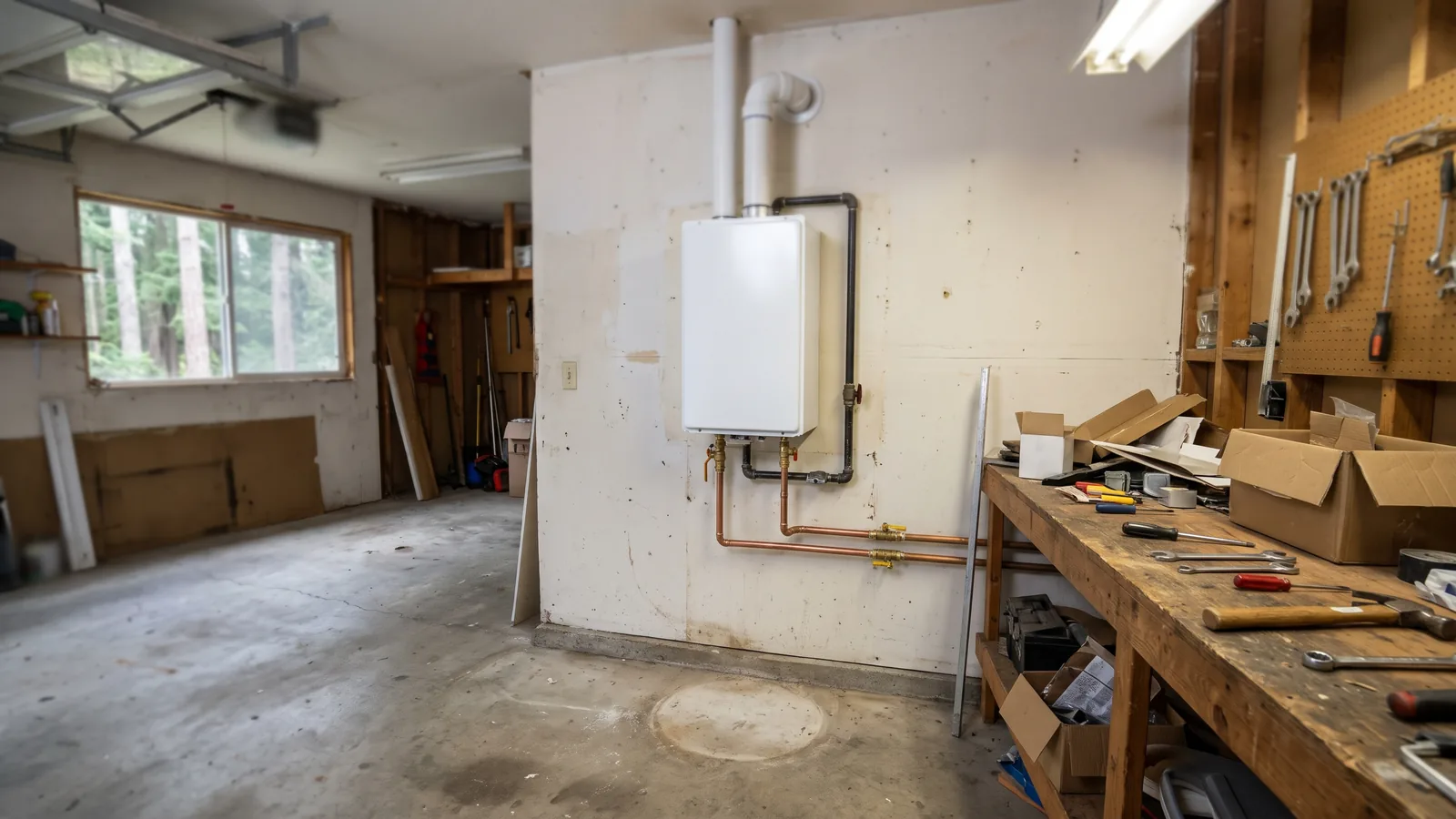
Point-of-Use Water Heaters for Single Sinks in Kent Homes and Shops
A point-of-use heater serves one fixture or a pair, so the choice depends on the sink, not the house.
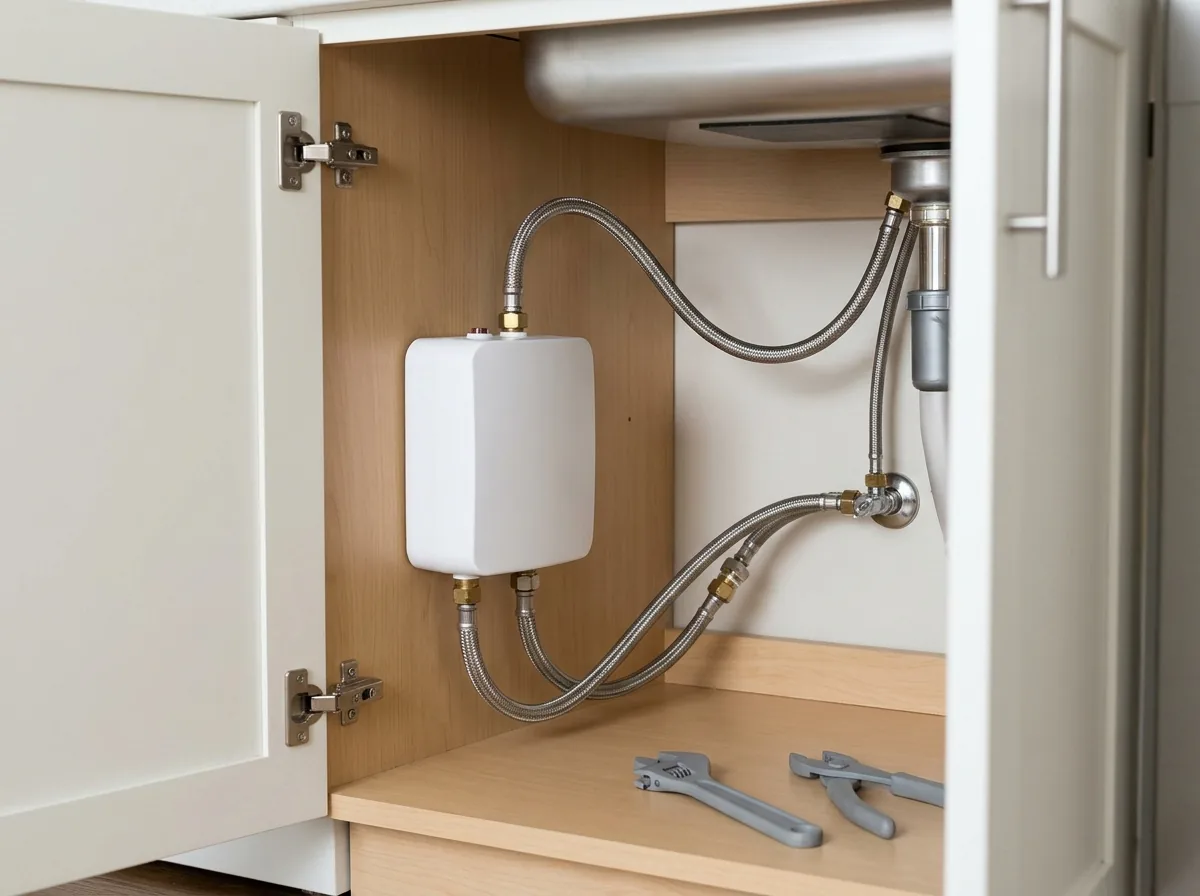
Under-Sink Electric Mini-Tanks
A mini-tank keeps a few gallons hot right under the sink. Stiebel Eltron's SHC line comes in 2.5, 4 and 6 gallons, hangs on a bracket and plugs into a 120-volt outlet. A.O. Smith's mini-tanks run 3 to 7 gallons nominal, and the company notes the stored water can run out under heavy use. Because it stores water, a mini-tank carries a relief valve, and its discharge pipe follows the rules on the leak repair page. Washington caps standby use for mini-tanks made since 2010 at 35 watts.
Small Tankless Units Under a Sink
A sink-sized tankless heater stores nothing and switches on when water flows. Stiebel Eltron's Mini measures 7.5 by 6.5 inches. The company says it needs no relief valve, drain or circulating pump; the plumbing code exempts listed instantaneous heaters 3 inches or less inside from the relief-valve rule. These units depend on low flow:
- Stiebel Eltron Mini: 0.32 to 1.0 GPM, set by the aerator supplied.
- EcoSmart POU 3.5: turns on at 0.25 GPM and ships with 0.35 GPM aerators.
A Booster for a Distant Bathroom
When a bathroom sits far from the main heater, cold water in the pipe comes out first. Stiebel Eltron sells its mini-tank as a booster on a long run from a remote heater, or in a recirculation loop. A.O. Smith makes the same case: a heater near the faucet avoids leaving hot water to cool in a long line. For a whole wing or several baths, a recirculation pump can be the better fix.
Break Room and Kitchenette Sinks
Offices and warehouses often have a lone sink a long way from any heater. Stiebel Eltron lists restrooms and kitchenettes in offices, warehouses, stores and schools as typical spots for its Mini. Food businesses are different. King County's plan review guide recommends hooking handsinks to the main water heater, because under-sink instant units may not hold the required 100°F; see restaurant hot water.
Garage and Shop Sinks
A.O. Smith lists garages, room additions and small apartments among common mini-tank installs. Angi's guide notes that adding point-of-use heaters can call for a new water line, at $400 to $2,000. Ask whether the sink already has a cold line and an outlet within reach; that sets most of the price.
Why Kent homeowners and businesses call Kent Tankless Water Heater
- Your details go to a single independent plumber, not a list of bidders
- The referral is free, and booking is your call
- Ask for gas line, vent and wiring costs as separate lines
- Ask which Kent and L&I permits the job needs
- Keep the down payment small and pay as work is finished
Power Needs by Size
The small units differ most in their electrical draw:
Plug-in mini-tank (Stiebel Eltron SHC)
120 volts, 11 amps, no special wiring.3.5 kW tankless (EcoSmart POU 3.5)
120 volts, 29 amps, one dedicated 30-amp single-pole breaker, 10 AWG wire.Whole-house electric tankless
a different class of load; panel size and breaker sizing are on the electric tankless page.
A new circuit means electrical work, and in Washington that permit comes from L&I rather than the city. If the panel is full, that cost can outweigh the heater.
Mini-Tank or Tankless Under the Sink?
Pick a mini-tank where the sink needs a decent flow for a short time, such as a kitchenette, and an outlet is already there. Pick a tankless unit where space is tight and low, steady flow is fine, like a handwashing sink, and a dedicated circuit is easy to add. EcoSmart notes its unit needs no venting, unlike a gas heater. In either case, ask the plumber to confirm the model's flow against the faucet you're keeping.