
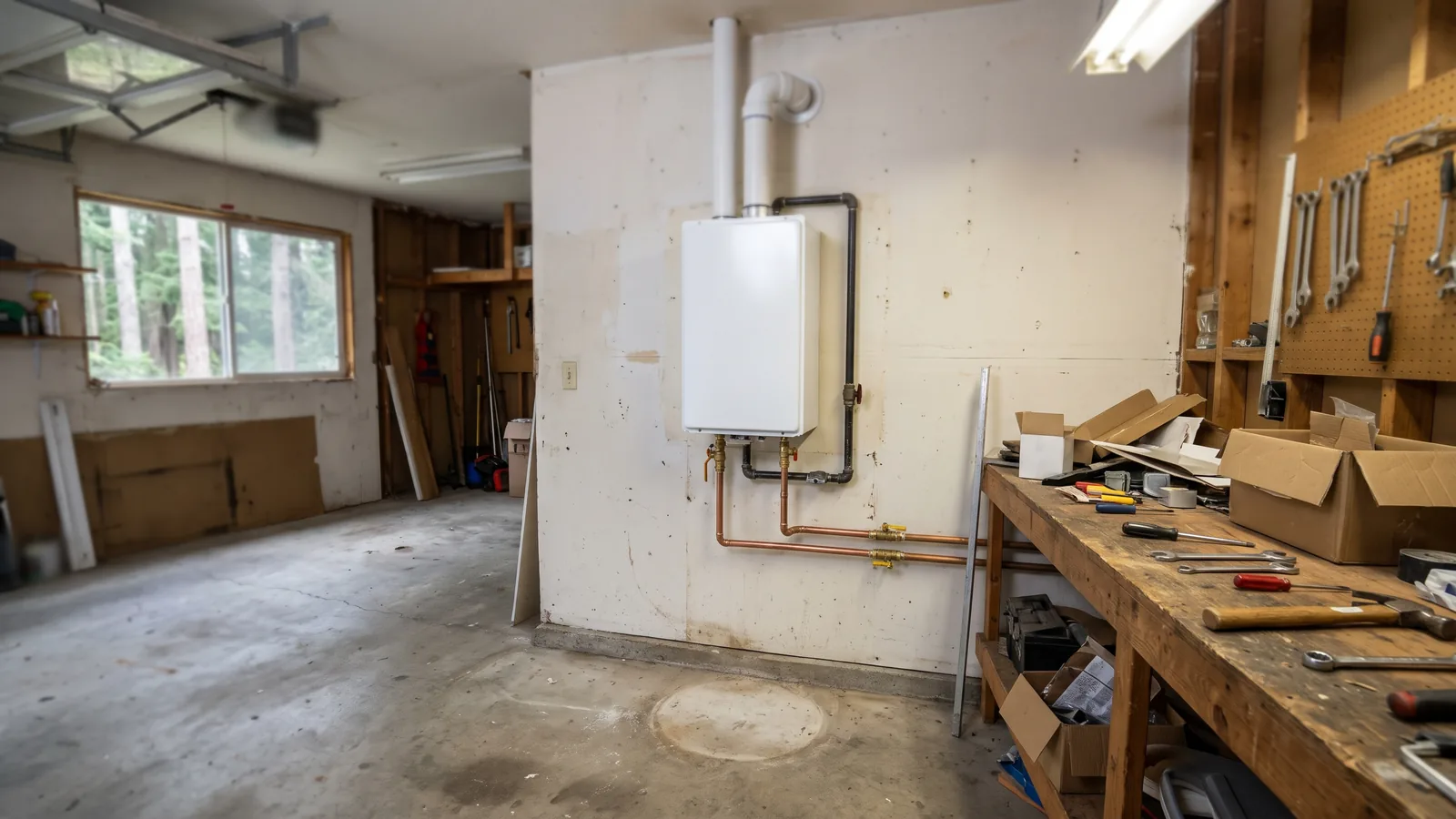
Electric Tankless Water Heater Sizes for Kent Homes
Electric units are sorted by kilowatts, and every step up in kW is a step up in breakers, wire and panel. Stiebel Eltron's Tempra line, one common whole-house range, shows how the numbers climb.
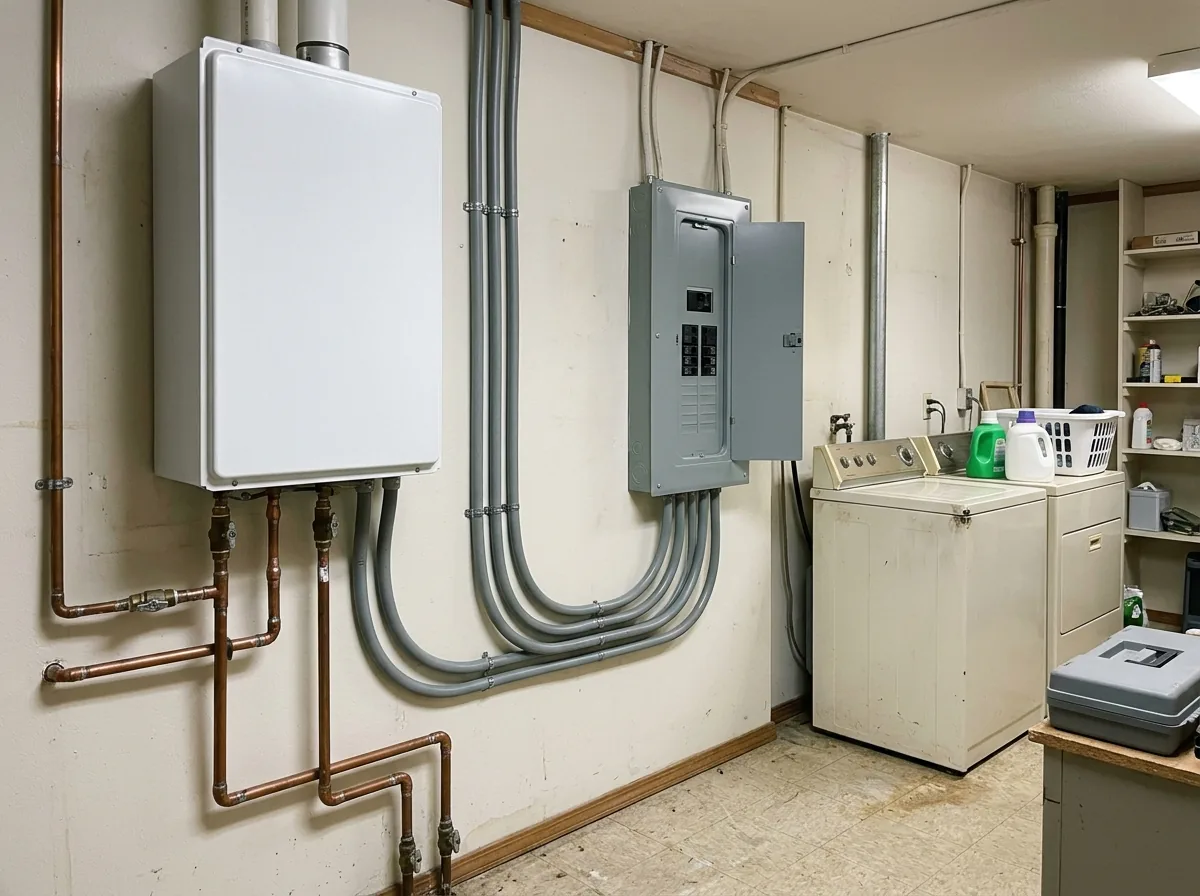
19 to 36 kW Units Sized for the Whole House
These are the units meant to replace a tank. Stiebel's whole-house models at 240 volts:
- Tempra 20: 19.2 kW, two 40-amp breakers.
- Tempra 24: 24 kW, two 50-amp breakers, 150-amp main service minimum.
- Tempra 29: 28.8 kW, three 40-amp breakers, 200-amp service.
- Tempra 36: 36 kW, three 50-amp breakers, 300-amp service.
At 240 volts the Tempra 36 draws 150 amps, half of the 300-amp service it calls for, which is why the panel check comes before the purchase.
Smaller Units That Serve One Bathroom
A smaller unit makes sense for a bathroom far from the main heater, a basement suite or an addition. Stiebel's Tempra 12 draws 12 kW on a single 50-amp breaker, and the Tempra 15 runs 14.4 kW on two 30-amp breakers. They turn on at low flow (0.37 gallons a minute for the 12 kW model), but their temperature rise is limited: about 54°F at 1.5 gallons a minute on the 12 kW unit. That covers one low-flow shower on Kent water, not two. Under-sink units for a single faucet are on the point-of-use page.
Breakers, Wire Gauge and Dedicated Circuits
Larger electric tankless units split their load across two or three circuits. From Stiebel's spec sheet:
- Breakers: double-pole, sized at 100% of the load, since a tankless heater counts as a non-continuous load.
- Wire: copper only, 10/2 to 6/2 AWG per run depending on the breaker, sized to keep voltage drop under 3%.
- Runs: one to three separate runs from the panel, one per breaker.
Stiebel says to check those against local codes. In Washington, that wiring needs an electrical permit from L&I, not the City of Kent, and an electrical contractor you hire buys its own permit.
150, 200 and 300 Amp Service Requirements
Angi notes that electric tankless units can draw 120 to 160 amps and may push a house to 200-amp service or more. Stiebel's minimums line up: 150 amps for its 24 kW model, 200 for 28.8 kW and 300 for 36 kW. Angi puts a new electrical line and sub-panel at $500 to $1,000, and complex rewiring at up to about $2,300. Ask the electrician for a load calculation, not a guess.
Why Kent homeowners and businesses call Kent Tankless Water Heater
- Your details go to a single independent plumber, not a list of bidders
- The referral is free, and booking is your call
- Ask for gas line, vent and wiring costs as separate lines
- Ask which Kent and L&I permits the job needs
- Keep the down payment small and pay as work is finished
Electric Tankless Sizing for Kent's Inlet Water
Sizing comes down to two numbers: how many gallons a minute the house draws at once, and how many degrees the heater has to add. DOE's method is to add up the flow of every fixture you'd run at the same time, then subtract the incoming water temperature from the temperature you want.
Inlet temperature is the local number in that math. DOE's default assumption is 50°F. Rinnai's ground water map puts western Washington around 52°F, a reading from its map zones rather than a measured Kent figure. For a 105°F shower, that's a rise of about 53°F; for 120°F at the tap, about 68°F.
Read against Stiebel's temperature-rise table at 240 volts:
| Model | Rise at 3.0 GPM | Rise at 4.5 GPM |
|---|---|---|
| Tempra 20 (19.2 kW) | 44°F | 29°F |
| Tempra 24 (24 kW) | 54°F | 37°F |
| Tempra 29 (28.8 kW) | 66°F | 44°F |
| Tempra 36 (36 kW) | 82°F | 55°F |
So on Kent water, a 24 kW unit holds shower temperature at about 3 gallons a minute: one 2 GPM shower and a sink. Two 2 GPM showers at once (4 GPM) take the 36 kW model, which still has about 55°F of rise at 4.5 GPM. Rinnai notes that inlet temperature shifts with the seasons, so size for the colder months. If the house needs more than a 36 kW unit gives, DOE's answer for a large household is two or more units, and it notes that gas units deliver higher flow than electric ones.